
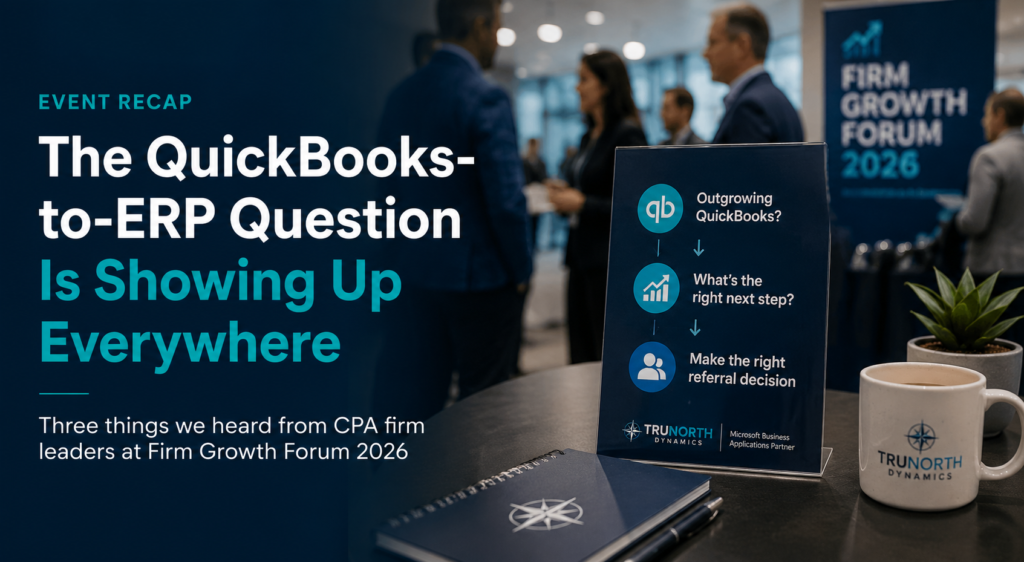
Three things we heard from CPA firm leaders at Firm Growth Forum 2026
We spent May 19 and 20 at Accounting Today’s Firm Growth Forum in San Diego with CPA firm owners, managing partners, CAS practice leads, and senior firm leaders.
This was TruNorth Dynamics’ first year attending and sponsoring the event, and the conversations were exactly the kind we hoped for: practical, direct, and very real.
We talked with dozens of firm leaders. We asked a lot of questions. And we heard the same theme again and again.
A client outgrows QuickBooks. The CPA gets asked what to do next. The firm wants to help, but they also know the risk. Recommend too early, and the client may overspend. Wait too long, and the finance team keeps fighting the same manual processes. Refer the wrong implementation partner, and the firm’s reputation is attached to the outcome.
That is not a small decision. It is one of the most important technology referral moments a CPA, CAS, or bookkeeping firm can face.
Three patterns came up over and over.
1. The QuickBooks question is already on every firm’s desk
Almost every firm leader we spoke with described some version of the same situation.
A client’s books are clean. The controller is capable. The team knows how to make QuickBooks work.
And still, the software is becoming the bottleneck.
Month-end takes too long. Multi-entity reporting happens in Excel. Leadership cannot get the answers they need without manual cleanup. Someone on the team has quietly become the person whose job is to keep the system, the spreadsheets, and the workarounds moving in the same direction.
Eventually, the client asks:
“What should we move to next?”
That is where the pressure lands on the CPA or advisor.
The client does not want a vague answer. They want plain language from someone they already trust. They want to know whether they are truly ready for a new system, what their options are, and who they can safely talk to next.
Most firms do not yet have a repeatable way to answer that question. They have impressions. They have a few names. They may have one past referral experience, good or bad.
That creates risk.
Several firm leaders told us they now avoid the ERP conversation because a previous referral went poorly. That is understandable. But when firms step away from the conversation entirely, the next client gets less guidance at the exact moment they need more.
That is the gap we kept hearing.
CPA firms are not looking for a software pitch. They are looking for a safer way to advise.
2. Firm leaders want practical Microsoft education before product detail
Many firm leaders we spoke with had heard of Dynamics 365. Some had heard of Business Central. Some had heard of Power Platform. But many did not yet have a simple working model for how the Microsoft business application stack fits together.
The most useful booth conversations were not feature demos. They were translation conversations.
Questions like:
“Where does Business Central fit?”
“When is this an ERP issue?”
“When is it really a reporting or workflow issue?”
“What does Power Platform actually do?”
“How would I explain this to a client without sounding like a software salesperson?”
Those are exactly the right questions.
A client who is outgrowing QuickBooks may not need to jump straight into ERP. Sometimes the issue is reporting. Sometimes it is approvals. Sometimes it is sales handoff, disconnected spreadsheets, manual reconciliations, inventory visibility, or a process that has outgrown the tools around it.
That is where the broader Microsoft suite matters.
Business Central may fit when the client needs stronger financial structure, inventory, projects, dimensions, approvals, or multi-entity support.
Power Platform may fit when the pain is workflow, reporting, approvals, or repetitive manual work.
Dynamics 365 Sales may fit when the front office is disconnected from finance and operations, and leadership cannot clearly see pipeline, customer activity, or handoff points.
Microsoft 365 and Teams may support the collaboration layer around all of it.
The bigger point is this: the first question should not always be, “Which ERP should they buy?”
The better question is, “Where is the business process breaking down?”
That is a much better starting point for a CPA, CAS, or bookkeeping advisor.
3. The implementation partner may be the real decision
The most experienced firm leaders were very clear on this point.
The software matters. But the implementation partner often matters more.
A good implementation partner can make a reasonable platform decision work. A poor implementation partner can turn even the “right” software into a bad experience.
That is what makes the referral so sensitive.
When a CPA firm refers a client to an implementation partner, they are not just passing along a name. They are attaching their credibility to the experience that follows.
The firms doing this well had a clear pattern. They did not refer blindly. They vetted partners carefully. They wanted to know who would actually do the work. They asked about methodology. They wanted references from similar clients. They cared about what happened after go-live. They wanted “done” defined before the project started.
That is exactly the right instinct.
The partner should be able to explain the process clearly. They should be honest about what is in scope and what is not. They should be willing to say when a client is not ready. They should be able to distinguish between a system issue, a process issue, a reporting issue, and a readiness issue.
And if the client is not a fit for a fixed-scope approach, the partner should say that too.
That is how trust gets protected.
What we took from the event
A few things became very clear over the two days.
First, the QuickBooks-to-ERP conversation is not rare. It is showing up regularly for CPA, CAS, and bookkeeping firms serving growing clients.
Second, most firms do not need more software noise. They need simple language, practical education, and a framework they can use before making a recommendation.
Third, the best referral partners are not the ones who push every client toward the same answer. They are the ones who help firms think clearly about fit, readiness, risk, and next steps.
That is the kind of partner TruNorth Dynamics is working to be.
Get the framework
We packaged our thinking into a free guide for CPA, CAS, and bookkeeping firm leaders.
It includes:
- Signs a client may be ready to move beyond QuickBooks
- False alarms that may not require ERP yet
- How to think about Microsoft business application fit
- Questions to ask before referring a client to an implementation partner
- A one-page decision framework you can share with a client
No sales call required.
We also run a structured referral program for CPA firms, bookkeeping firms, fractional CFOs, and trusted advisors. If you would like to compare notes on a specific client conversation or talk about how partnership might fit your firm, reach out at SalesTeam@trunorthdynamics.com.
Thanks to the Accounting Today team for a strong event, and to everyone who stopped by, asked thoughtful questions, and shared what this conversation looks like inside your firm.
Michelle Serna
SVP Revenue, TruNorth Dynamics