
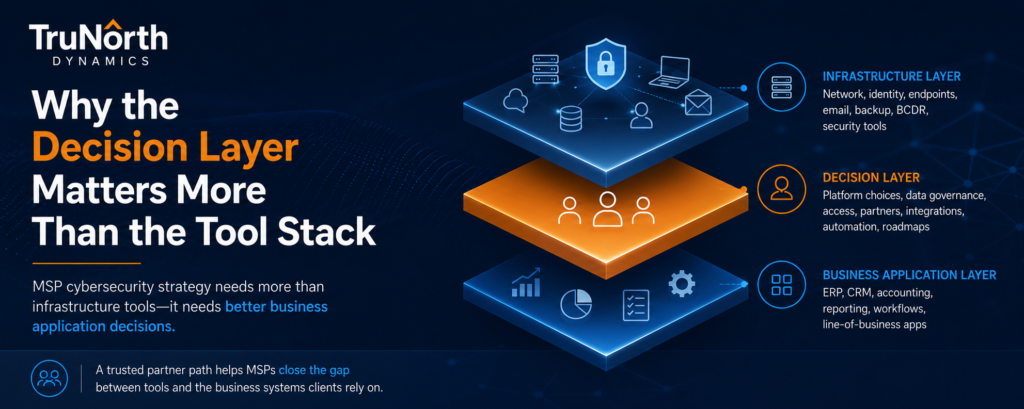
Every cybersecurity conversation seems to start with tools. EDR. MDR. MFA. SIEM. Backup. BCDR. Identity platforms. Email security. Vulnerability management. Those tools matter, and most mature MSPs have built strong practices around them.
But tools do not make decisions. People do. And many of the decisions that shape security, governance, and operational resilience happen outside the infrastructure stack.
That is why MSPs need to pay attention to the decision layer.
What is the decision layer?
The decision layer is the space between the infrastructure an MSP manages and the business applications a client uses to run the company.
The infrastructure layer includes the systems MSPs typically protect: network, identity, endpoints, email, backup, BCDR, and security tooling. The business application layer includes ERP, CRM, accounting systems, reporting tools, workflow applications, and line-of-business platforms.
The decision layer is where questions like these get answered:
- Which ERP should we move to when the current system becomes too difficult to support?
- Who owns the data inside the accounting system, CRM, or reporting platform?
- Which partner should help us implement Dynamics 365 or Power Platform?
- How will administrative access, integrations, and service accounts be governed?
- Should this workflow be automated, and who will review it before it touches production data?
- What happens when a new CFO, acquisition, audit finding, or reporting need pushes the client toward a platform decision?
Those questions do not belong exclusively to the MSP. They also do not belong exclusively to the client’s finance, operations, or sales teams. They sit in the middle, where technology strategy, security posture, business process, and operational flow intersect.
When the decision layer is ignored, the client still makes decisions. They simply make them without the right guidance in the room.
Why the tool stack cannot close this gap alone
A strong cybersecurity stack can reduce exposure, improve detection, enforce identity controls, and protect recoverability. But even the best stack is limited by the environment it is asked to protect.
If a client is running an aging ERP on unsupported infrastructure, the issue is not only whether endpoint protection is installed. It is whether the business has a path off a platform that is becoming harder to patch, govern, and support.
If a controller chooses a new accounting application without IT involved, the issue is not only whether MFA can be turned on later. It is whether data, identity, integrations, permissions, and reporting were considered before the system became operational.
If business users build Power Automate flows or Power Apps without governance, the issue is not only whether those users have licenses. It is whether automation is being designed with appropriate data access, documentation, ownership, and change control.
The tool stack matters. But it does not replace the need for better platform decisions.
The cost of ignoring the decision layer
The decision-layer gap usually does not appear as one dramatic failure. It shows up as small, familiar patterns that compound over time.
Legacy systems remain in place because no one owns the roadmap. Reporting is built through exports and spreadsheets because no one trusts the source data. Users create workarounds because the official process is too slow. Partners retain access longer than they should because no one owns the offboarding process. New tools enter the business because a department needed a quick fix and did not know who to ask.
Each decision may seem reasonable in isolation. Together, they create a technology surface that is harder to secure, harder to audit, harder to support, and harder to scale.
Why this matters for MSPs
MSPs often feel the downstream effects of business application decisions they did not make. A client changes finance systems and then asks why reporting access is inconsistent. A sales team adopts a CRM and then asks for identity support. A department builds automation and then needs help when it breaks. A poor implementation partner leaves behind unclear access, weak documentation, or stalled projects.
The MSP may not own the application, but the client often sees technology as one connected experience. When something fails, they call the advisor they trust.
That creates both a risk and an opportunity. The risk is being pulled into the aftermath of decisions made without you. The opportunity is building a partner path so clients can make those decisions with guidance before they become problems.
The partner model: close the gap without becoming the ERP team
Closing the decision-layer gap does not require MSPs to become Dynamics 365 implementers, ERP consultants, or business process redesign teams. It requires a trusted partner relationship that gives the MSP a better answer when business application triggers appear.
The motion is simple. The MSP hears the trigger. The MSP makes a warm introduction. The business applications partner leads discovery, scoping, and delivery. The MSP stays informed and remains the trusted advisor. The client experiences a coordinated team rather than a disconnected set of vendors.
For MSPs, this protects focus. Your team continues to own infrastructure, security, identity, endpoint, email, backup, BCDR, and advisory services. A partner like TruNorth Dynamics handles Dynamics 365, Power Platform, AI, and business application strategy. The client gets clearer business flow, and the MSP creates referral revenue without adding project delivery overhead.
What the decision layer looks like in practice
Imagine a 60-person manufacturing client during a quarterly business review. The controller mentions that they are still on Dynamics GP and that the upgrade has been pushed back again. Six months ago, the MSP may have acknowledged the comment and moved on because ERP was outside the scope of the relationship.
In a decision-layer model, the MSP responds differently: “That sounds like a system decision that could affect reporting, security, and future scalability. We have a partner who specializes in Dynamics and business application strategy. Would it be helpful if we made an introduction?”
The introduction creates a better path. The client gets a discovery conversation before the issue becomes urgent. The MSP stays aligned with the broader technology posture. The Dynamics partner evaluates the business application roadmap, migration considerations, security and identity implications, and process needs. The project, if it moves forward, is guided instead of reactive.
That is the decision layer working. Not because the MSP added another tool, but because the client made a better decision with the right people in the room.
How MSPs can start
The first step is not a new service line. It is awareness. Train your account managers, vCIOs, service leaders, and client-facing consultants to recognize the signals that a business application decision is forming.
Listen for comments about old ERP systems, poor reporting, unhappy Dynamics partnerships, manual workarounds, new executives, acquisitions, audit findings, and unmanaged automation. These comments are often early warnings that the client is approaching a decision with security, data, and operational consequences.
The second step is prioritization. Use a scorecard to identify which clients have the most signals. Start with the top five. Bring those names to your next account review and decide where a partner intro would be helpful.
The third step is building the partner path before the client needs it. Meet with TruNorth, align on the referral process, agree on messaging, and make sure your team knows exactly what to do when the next trigger appears.
Next step
If this maps to clients in your book, TruNorth has two resources built from the ChannelPro Deep Dive session.
The 10-Signal Client Opportunity Scorecard helps you identify which clients are ready for a Dynamics conversation. It takes about 15 minutes to run against your existing list.
The MSP Partnering Playbook explains the full decision-layer framework, the six trigger phrases, the referral motion, and the 90-day path for building this into your practice.
The decision layer is where technology strategy becomes security posture. MSPs do not have to own that layer alone, but they do need a trusted way to guide it.
Frequently asked questions
What is the decision layer in MSP cybersecurity?
The decision layer is the set of business application and platform decisions that sit between the infrastructure an MSP manages and the systems a client uses to run the business. It includes decisions about ERP, CRM, accounting systems, reporting, automation, data ownership, partners, governance, and administrative access.
Why does the decision layer matter for MSPs?
The decision layer matters because clients often make business application decisions that affect security, identity, data, reporting, and compliance. Even if the MSP does not deliver the application work, the MSP may inherit the downstream risk or support impact.
How can MSPs address business application risk without expanding delivery?
MSPs can address business application risk by building a partner relationship with a trusted Dynamics and business applications firm. The MSP recognizes the trigger, makes a warm introduction, stays aligned, and lets the partner lead discovery and delivery.